
A toy that sings, flashes, and does all the work tends to lose its appeal within weeks. A plain set of blocks can hold a child’s attention for years. The difference usually comes down to how much the toy asks of the child.
That question gets harder when the gift has a screen or a battery. Parents searching for great tech gifts for young kids and toddlers are often balancing two goals at once: giving a child something genuinely engaging, and keeping screen time from sliding into passive consumption. The same device can be a drawing tool, a story reader, or an autoplay video machine depending on how it is set up. The ideas below focus on the first two outcomes.
Quick Answer
The best gifts for creativity, learning, and independent play share three traits: they are open-ended enough that the child decides what happens next, they can be used without an adult sitting alongside, and they give quick, clear feedback. For tech gifts, that usually means a kid-friendly tablet with curated content and a drawing or reading app, an audio player with physical controls, or a simple sequencing toy — not a device that plays videos on a loop.
Key Takeaways
- Open-ended gifts outperform feature-packed ones because the child, not the toy, controls the outcome.
- A tech gift only supports independent play if a child can start it, change it, and stop it alone.
- Age labels on packaging are a starting point, not a decision — temperament and current skills matter more.
- Rotating a small set of toys keeps them interesting longer than adding new ones.
- Passive screen time is not automatically harmful, but the balance between passive and active use is what shapes the outcome.
What Actually Makes a Gift Encourage Independent Play
A gift supports independent play when a child can begin, adjust, and finish the activity without an adult stepping in. That sounds simple, but it eliminates a surprising number of popular toys.
Five qualities do most of the work:
- Open-ended outcome. Blocks, crayons, and play silks can become anything. A toy with one correct result gets boring once that result is reached.
- Self-correcting feedback. A puzzle piece either fits or it doesn’t. A stacking ring either balances or falls. The child learns without needing a parent to confirm anything.
- Low setup cost. If a toy requires an adult to assemble, load, pair, or log in every time, it will not be used independently.
- Adjustable difficulty. A gift that grows with the child — a building set that starts as stacking and later becomes a castle — stays in rotation far longer.
- Durability. Independent play is hard on toys. Anything that breaks under normal toddler handling becomes a frustration for everyone.
A useful test: hand the child the item and watch for ninety seconds. If they can figure out something to do with it in that window, it will likely get used. If they hand it back, the toy is doing the work and the child is watching.
Tech Gifts That Earn Their Place in a Toy Rotation
Tech is not automatically worse for young children than wooden toys. What matters is the loop it creates: does the child act and the device respond, or does the device perform while the child absorbs? The first builds skills; the second fills time.
Kid-Friendly Tablets
A tablet set up with a drawing app, an audiobook library, and a handful of puzzle or story apps behaves completely differently from the same tablet with open access to an app store and autoplay video. The hardware is neutral — the curation decides the outcome.
What to look for: a parent dashboard that lets you set time limits and approve content, a rugged case that survives drops, and enough storage for offline downloads so the device still works on car trips. What to watch for: subscription layers that quietly unlock more content than you intended, and app stores that are easier for a four-year-old to navigate than you expect.
Audio Players and Story Devices
Screen-free audio players are one of the strongest categories for independent play because a child can operate them alone using physical buttons. They work well during quiet time, in the car, and at bedtime, and they build listening comprehension and vocabulary without any visual stimulation.
The trade-off is content. Many devices rely on a subscription or a card-based library, so the real cost is ongoing rather than one-time. Check what comes included before assuming the purchase price is the full price.
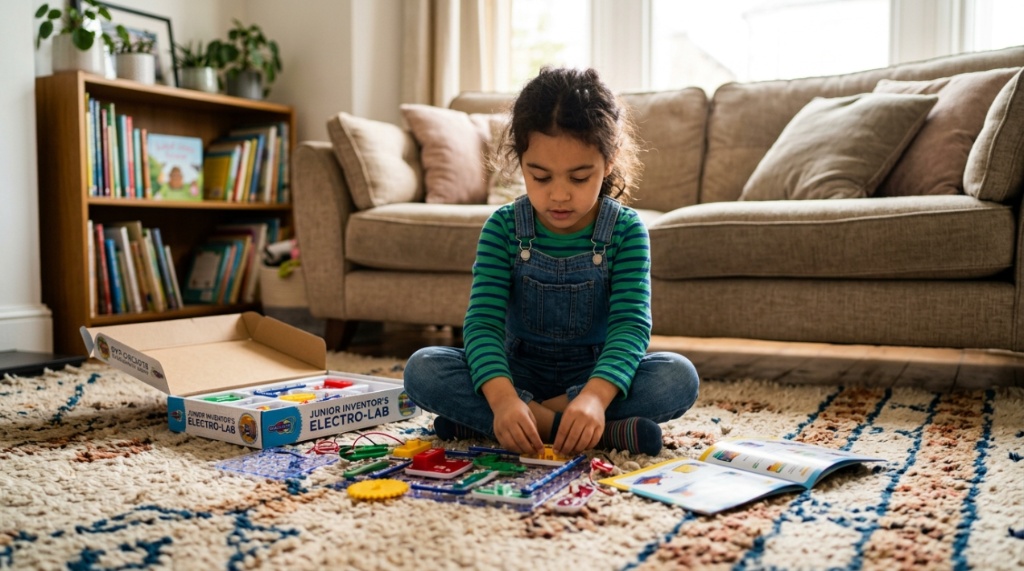
Interactive Learning Toys and Beginner Sequencing Sets
For toddlers, this category is mostly cause and effect: press a button, hear a sound, see a light. For children around four and up, simple sequencing toys let a child plan a short series of steps and then watch the result.
Be realistic about the “coding” label. Many toys marketed as coding tools actually teach following instructions in order, which is a genuine and useful skill — but it is not programming. That is fine as long as you are not expecting the toy to produce a future software engineer.
Non-Tech Gifts That Do the Same Job
Some of the most effective gifts for creativity and independent play have no batteries at all. Magnetic tiles, wooden blocks, play silks, washable crayons and paper, simple jigsaw puzzles, and pretend-play props all share the same advantage: they can be reconfigured endlessly, they need no charging, and they never run out of content.
These also tend to survive sibling hand-me-downs, which is worth factoring in if you are buying for a family with more than one young child. A gift that a two-year-old uses as a stacking toy and a five-year-old uses as a castle foundation has a much longer useful life than a single-purpose electronic toy, To support your child’s overall development beyond playtime, you might also want to read our guide on building strong foundations: early learning and social growth for young minds.
Matching the Gift to Age and Temperament
Age ranges on packaging describe the minimum safe age and the average developmental stage. They do not describe your specific child. Use them as a filter, then adjust for what the child actually does.
- 12–24 months: Cause-and-effect toys, chunky stacking pieces, board books, and anything without small parts. Independent play sessions are short — often under ten minutes.
- 2–3 years: Pretend play props, simple matching games, first audio players with large buttons, and large-piece puzzles.
- 4–5 years: Building sets, drawing and craft supplies, rule-based games with simple instructions, and tablet apps that involve creating rather than watching.
- 6–7 years: Early sequencing toys, chapter-length audiobooks, more complex builds, and projects that take more than one sitting to finish.
Temperament matters just as much. A high-energy child often does better with gifts that involve movement or building something large. A slow-to-warm child may need a lower-stakes entry point — a toy that cannot be done “wrong.” A child who already reads independently may get more from an audio player than from another tablet app.
Passive vs. Active Tech Gifts: A Quick Comparison
| Type | What the child does | Independent play potential | Main drawback |
|---|---|---|---|
| Autoplay video device | Watches | Low | Displaces other play and is hard to stop |
| Tablet with curated creative apps | Draws, solves, decides | Moderate to high | Requires ongoing content curation by a parent |
| Screen-free audio player | Chooses, listens, follows along | High | Often tied to a subscription or card library |
| Simple sequencing toy | Plans, tests, corrects | Moderate | Usually needs adult help in the first few sessions |
Common Mistakes That Undermine a Good Gift
Most gift failures are not the toy’s fault. They come from how the gift is introduced and stored.
- Buying for the parent’s interests. A beautifully designed wooden marble run is a poor gift for a child who wants to throw things.
- Too many features. A toy with twelve buttons and four modes usually gets used in one mode, or not at all.
- Gifts that require an adult every time. If the child cannot start it alone, it becomes a request for attention rather than an activity.
- No rotation system. Twenty toys on the floor at once means none of them gets deep attention.
- Treating screen time as all-or-nothing. Banning tech entirely often makes it more exciting; allowing unlimited passive video makes it the default.
How to Set a New Gift Up for Long-Term Play
- Play together the first two or three times so the child sees what is possible, then step back and let them take over.
- Set it up so the child can start alone — charge it, load the content, and place it at their height.
- Keep six to eight items accessible and store the rest. Rotate every couple of weeks.
- Watch for the drop-off signal. If something has been ignored for two weeks, rotate it out rather than buying a replacement.
- Add one new element instead of a new toy — new colors for the easel, a different audio card, a larger base plate.
Frequently Asked Questions
Are tech gifts bad for toddlers?
No, but the type of use matters. A toddler tapping a drawing app or listening to a story is engaged differently than one watching autoplay video. The concern is not the device itself but how much of the child’s time goes to passive consumption versus active participation.
What age is a kid-friendly tablet appropriate?
Many families introduce one around age three or four, when a child can follow simple instructions and understand basic limits. Some children are ready earlier, and some do better waiting. The bigger factor is whether you are willing to curate content and set consistent time boundaries.
How do I keep a gift from becoming a screen-time problem?
Set the device up before giving it, decide in advance what apps are available, and use the built-in time limits rather than negotiating in the moment. A device that has a clear, predictable stopping point causes far fewer conflicts than one that ends whenever a parent says so.
Do “educational” toys actually teach anything?
Some do, but the label is used loosely. Toys that teach letters, numbers, or sequencing through repetition and feedback tend to have real, if modest, effects. Toys that claim broad cognitive benefits without a specific skill usually deliver entertainment rather than measurable learning.
What if my child loses interest in a gift after a week?
That is normal and not a sign you chose badly. Put it away for two or three weeks and bring it back out. Novelty fades quickly, but a well-made open-ended toy often gets a second, longer life after a break.
Should I buy tech or non-tech gifts for a two-year-old?
For most two-year-olds, non-tech gifts do more work: blocks, stacking toys, board books, and pretend-play props. If you want to introduce tech, a screen-free audio player with large buttons is usually a better first step than a tablet.
Conclusion
The gifts that last are the ones that hand control to the child. Whether it is a tablet loaded with drawing apps, a screen-free audio player, or a simple set of magnetic tiles, the pattern is the same: the child decides what happens next, and the toy responds. Start with one or two well-chosen items rather than a pile, set them up so they can be used alone, and rotate rather than replace when interest fades. That approach does more for creativity and independent play than any single purchase.