Setting up a home training space feels exciting at first. You bring in your bike, clip in, and start riding. Then, a few weeks later, you notice something troubling. There are scuff marks on your hardwood floor. Your carpet has compressed unevenly. Or your bike has developed a slight wobble because it is rocking on an uneven surface.
These problems are more common than most people realise. They are also entirely preventable with one simple addition to your setup: an indoor cycling mat.
A good mat does more than sit under your bike. It protects your floor, stabilises your equipment, absorbs noise, and makes your training space safer and more comfortable. This article explains exactly how it works and why every home cyclist should have one.
The Real Damage an Indoor Bike Can Do to Your Floor
Most people underestimate how much stress a stationary bike places on a floor. The bike itself is heavy, often weighing between 20 and 40 kilograms. Add your body weight on top of that, and you have a significant load pressing down on a relatively small footprint.
During a hard session, the situation intensifies. Standing climbs, sprint intervals, and heavy resistance efforts cause the bike to flex and shift slightly. This movement creates friction between the bike’s feet and the floor beneath it. Over time, that friction leaves marks, scratches, and grooves in the surface.
Hardwood and laminate floors are particularly vulnerable. A single intense session can leave permanent scuffs that are expensive to repair or refinish. Additionally, tiles can crack under repeated impact stress, especially if there are any small imperfections in the grout or subfloor beneath.
Carpeted floors face a different problem. The constant pressure and micro-movement of the bike compresses carpet fibres and can even damage the underlying pad. Over months of daily training, this creates a permanent indentation that no amount of vacuuming will fix.
Therefore, placing a protective layer between your equipment and your floor is not optional. It is a basic requirement for any home training setup.
How a Mat Absorbs Vibration and Impact
Every pedal stroke generates force. Some of that force goes into moving the flywheel, but a portion travels downward through the frame and into the floor. This is called vibration transmission, and it adds up quickly over the course of a session.
A quality indoor cycling mat is made from dense rubber or EVA foam, both of which are excellent at absorbing vibration. The material compresses slightly with each impact and then rebounds, dissipating the energy before it reaches the floor below. This reduces the repetitive stress that causes long-term floor damage.
Vibration absorption also has a secondary benefit. It reduces the noise your bike produces during training. Hardwood and tile floors act like amplifiers, bouncing sound around the room and into the spaces below. A thick rubber mat breaks that transmission path significantly. This is especially valuable in apartments or multi-storey homes where noise travels easily through the building structure.
Additionally, less vibration means less wear on the bike itself. Joints and connections stay tighter for longer when they are not being rattled against a hard surface repeatedly. Over time, this can reduce maintenance needs and extend the life of your equipment.
Stability and Safety During Intense Efforts
Floor protection is the most obvious benefit of a cycling mat, but stability is arguably more important. A bike that shifts or rocks during a hard sprint is not just annoying. It is a genuine safety risk.
Smooth floors like hardwood, tile, and polished concrete offer very little grip for the rubber feet of a stationary bike. During high-intensity efforts, the bike can creep forward or sideways. Even a small amount of movement breaks your pedalling rhythm and increases the risk of losing control at high cadence.
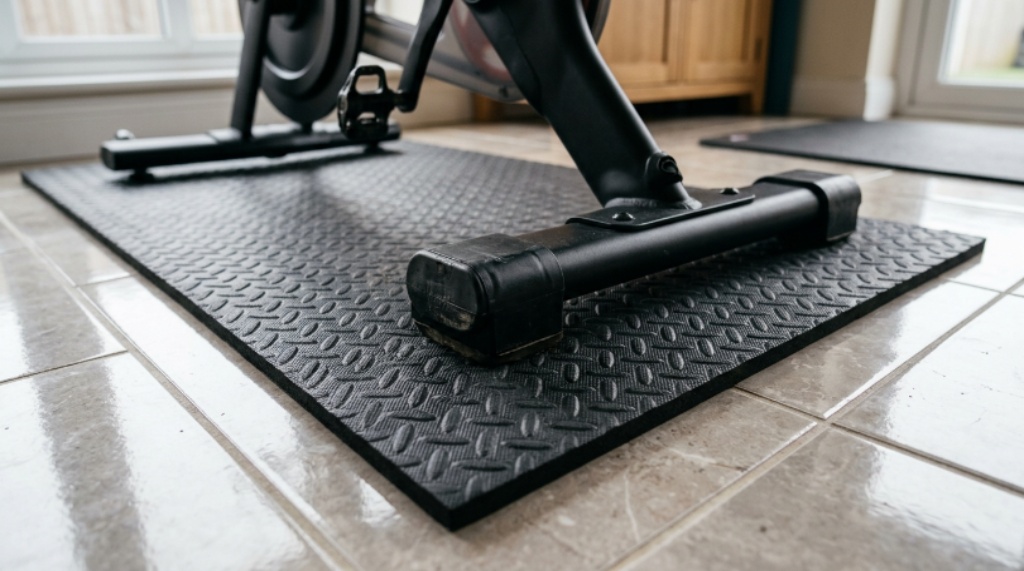
A stationary bike mat solves this problem directly. The textured surface grips both the floor below and the bike’s feet above, locking the equipment in place. An anti-slip workout mat with a high-friction surface is particularly effective for this purpose. It keeps your setup stable through the most aggressive intervals, giving you the confidence to push harder without worrying about the bike moving beneath you.
This stability benefit extends beyond cycling. Any home exercise equipment placed on a mat performs more predictably and safely. Treadmills, rowing machines, and weight benches all benefit from the same combination of grip and vibration absorption.
Protecting Different Floor Types
Not all floors need the same level of protection. Understanding what you are working with helps you choose the right mat for your situation.
Hardwood and Laminate Floors
These surfaces are the most sensitive to scratching and scuffing. A mat with a smooth, non-abrasive underside is essential here. Rough rubber can sometimes leave marks of its own on delicate finishes, so look for mats specifically rated as safe for hardwood. PVC and smooth-backed rubber options are both reliable choices.
Tiled Floors
Tiles are harder and more resistant to surface damage, but they are vulnerable to cracking under point loads. A mat distributes the weight of your bike more evenly across a larger surface area, reducing the pressure at any single point. This protection is particularly important over older tiles or grout lines that may already have minor weakness.
Carpeted Floors
Carpet needs protection from compression rather than scratches. A firm, dense mat placed over carpet prevents the bike’s feet from sinking in and damaging the fibres below. Additionally, a mat on carpet provides a more level and stable base for the bike, which improves your riding position and reduces strain on your joints.
Concrete Garage Floors
Concrete is tough and resistant to most damage, but it is unforgiving underfoot and transmits vibration efficiently. A mat in a garage setup adds cushioning, reduces noise, and protects the bike’s feet from the abrasive concrete surface. It also makes the space significantly more comfortable to stand in before and after your ride.
What to Look for When Choosing a Cycling Mat
Buying the right mat is straightforward once you know what matters. Several key features determine whether a mat will perform well under daily training conditions.
Thickness
Thickness determines how much vibration and impact the mat can absorb. A mat that is 5 to 8 millimetres thick works well for moderate training. For intense daily sessions or heavy equipment, a thickness of 8 to 12 millimetres provides better protection and noise reduction. Anything thinner than 5 millimetres offers minimal benefit beyond basic scratch protection.
Material
Rubber is the most durable and effective material for a cycling mat. It handles heavy loads, resists compression over time, and provides excellent grip on most floor types. EVA foam is lighter and more affordable but compresses permanently under sustained heavy weight. For a stationary bike used daily, rubber is the stronger long-term investment.
Size
The mat should extend at least 30 centimetres beyond the bike’s footprint on all sides. This accounts for the natural movement of the bike and gives you space to stand comfortably when mounting and dismounting. Standard cycling mats measure around 90 by 150 centimetres, which suits most setups well.
Surface Texture
The top surface should be textured enough to hold the bike in place but smooth enough to clean easily. Sweat and water will land on the mat during every session, so a surface that can be wiped down quickly is a significant practical advantage.
Maintaining Your Mat for Long-Term Performance
A cycling mat is a low-maintenance product, but a little attention keeps it performing well for years. After each session, wipe the surface down with a damp cloth to remove sweat and moisture. Sweat is mildly acidic and can degrade some rubber compounds over time if left to dry repeatedly on the surface.
Every few weeks, move the bike off the mat and clean both sides thoroughly. This prevents moisture and debris from being trapped beneath the mat, which can cause mould or floor damage in humid environments. Additionally, check the mat periodically for signs of compression or cracking, particularly around the areas where the bike’s feet sit. These are the highest stress zones and will show wear first.
With proper care, a quality rubber mat can last five to ten years of regular use, making it one of the best value additions to any home training setup.
Conclusion
An indoor cycling mat is a small investment that protects a large one. Your floors, your bike, and your safety all benefit from having the right mat in place before you start training.
Vibration is absorbed before it reaches the floor. Surfaces are shielded from scratches, scuffs, and compression damage. Your stationary bike stays firmly in place through the most demanding efforts. And your sessions are quieter, smoother, and safer from the first pedal stroke to the last.
Whether you ride on hardwood, tile, carpet, or concrete, a properly chosen mat makes your training space work better. It is one of the simplest upgrades available for home exercise equipment, and it is one that every indoor cyclist will notice immediately. Protect your floor now, and it will stay in good condition long after your training goals have been reached.
Frequently Asked Questions
Do I really need a mat if I already have carpet?
Yes. Carpet may seem like a soft, forgiving surface, but it is actually vulnerable to compression damage from heavy equipment. A mat distributes the weight more evenly, prevents permanent indentation of the carpet fibres, and provides a more stable, level base for your bike.
What thickness of mat is best for an indoor cycling bike? For most home setups, a mat between 6 and 10 millimetres thick provides the best balance of vibration absorption, floor protection, and durability. Heavier bikes or very intense training styles benefit from the thicker end of that range.
Can a cycling mat be used under other types of gym equipment?
Absolutely. A quality rubber mat works equally well under treadmills, rowing machines, ellipticals, and weight benches. The same benefits of floor protection, vibration absorption, and stability apply to all heavy home exercise equipment.
Will a rubber mat damage my hardwood floor?
A mat designed for hardwood use will not cause damage. Look for products with smooth, non-pigmented rubber backing and check that they are labelled as safe for finished wood surfaces. Avoid mats with bright-coloured or heavily textured undersides, as these can sometimes transfer dye or cause minor abrasion on delicate finishes.
How do I stop my mat from sliding on a smooth floor?
Choose a mat with a high-friction rubber underside rather than a foam or PVC backing. If your floor is particularly smooth, a small amount of anti-slip tape under the mat corners adds extra security. Additionally, make sure the mat is large enough that it cannot easily shift during use.